
How NRL betting actually works in New Zealand — odds, monopoly and what each operator offers
 Available in US

NRL is the only rugby league competition Australian bookmakers and TAB NZ treat as the national top-flight, and the betting conversation around it reaches New Zealand through a thinner funnel than it reaches Sydney. Since an amendment to the Racing Industry Act 2020 took force on 28 June 2025, TAB NZ and its online sister brand Betcha are the only operators permitted to take online sports and racing bets from people in New Zealand. Anyone comparing “NZ NRL bookmakers” is, in practice, comparing the two faces of one operator against everything else a New Zealand punter can reach over a VPN. That monopoly shapes everything else on this page — what markets exist, how prices are built, who oversees complaints and which harm-minimisation tools sit behind the bet slip. What follows walks from the bet types and odds, into the tournament itself, through ten operators ranked by the same criteria, then into the statute, the safety net and the forecasting question readers actually arrive with.
Current as of October 30, 2026 · checked against the Racing Industry Act 2020 (section 74AAA), the Department of Internal Affairs gambling pages, the New Zealand Racing Board entry on the New Zealand App Store and the Wikipedia entry for the 2026 NRL season.
Bet types and odds in NRL betting
A price on an NRL match is not a probability — it is a probability with the operator’s margin already taken out. Before the first siren sounds, every market carries a built-in house edge that decides what the bookmaker keeps on every dollar wagered on it. Reading NRL odds well means seeing that edge in the numbers and letting it decide which markets are worth a stake.

How decimal odds translate into return
The form a New Zealand punter meets on a TAB slip is decimal odds — the price that multiplies the stake into the total return, profit included. A $10 wager at $1.90 returns $19: the original $10 stake and $9 in profit. A multi does the same multiplication leg by leg before the stake goes in once at the end, which is why a four-leg multi at $1.90, $1.70, $2.20 and $1.50 has a final price of $1.90 × $1.70 × $2.20 × $1.50 = $10.69 — a $10 stake returns $106.90 if every leg lands. The multiplication is the easy part; the harder question is what the price is really saying about the chance of each leg winning.
Where the bookmaker’s margin sits
The cleanest place to see a margin is a two-way market with no draw — head-to-head, line betting, total points. Take an illustrative two-way market at $1.90 / $1.90: the payout share is 1 ÷ (1/1.90 + 1/1.90) = 1 ÷ (0.5263 + 0.5263) = 1 ÷ 1.0526 = 0.9500 — 95.00 % of every dollar wagered comes back to punters on average; the margin is the remaining 5.00 %. Move the prices to $1.80 / $2.00 and the share drops to 1 ÷ (0.5556 + 0.5000) = 1 ÷ 1.0556 = 94.74 %, a margin of 5.26 %. Move to $1.95 / $1.95 and the share climbs to 1 ÷ (0.5128 + 0.5128) = 1 ÷ 1.0256 = 97.50 %, a margin of 2.50 % — tighter, sharper, the kind of price a serious punter prefers.
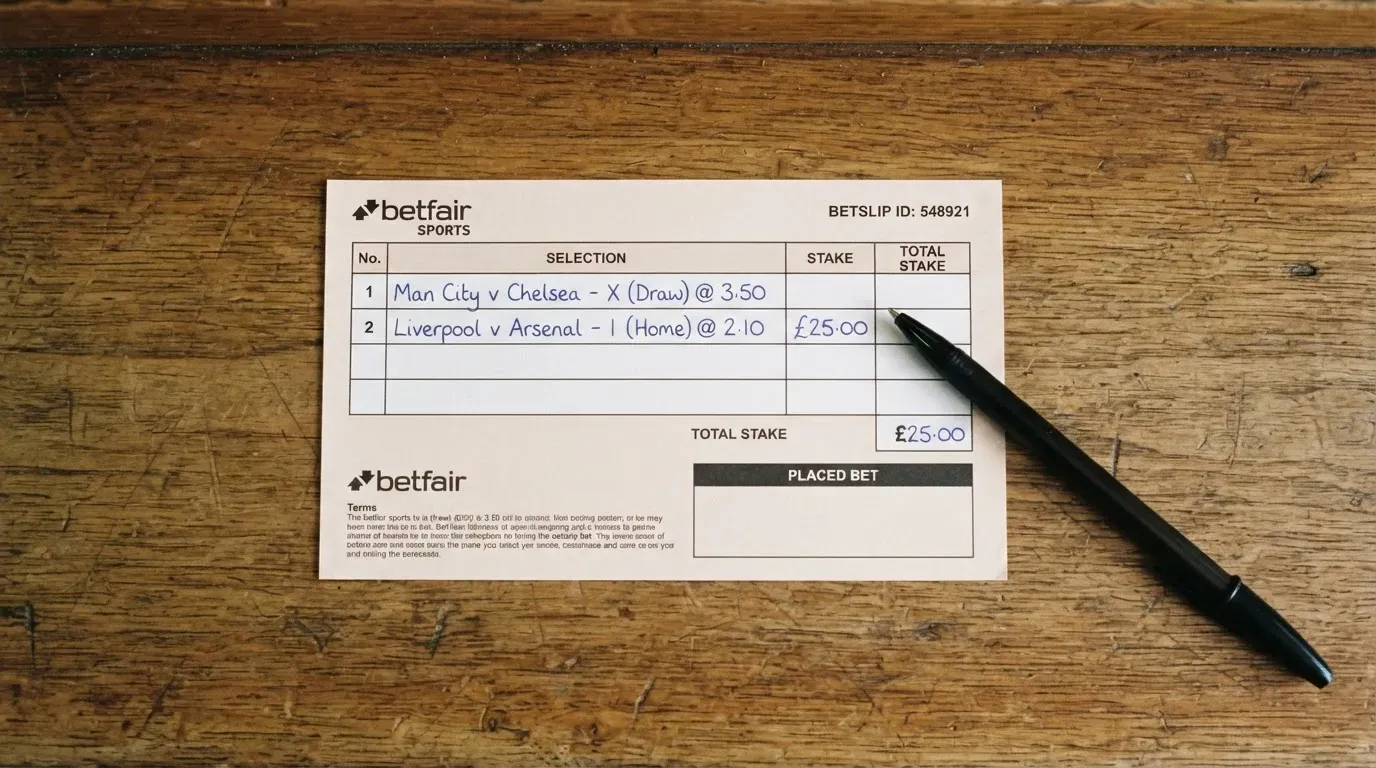
NRL match result (1X2 with a draw) has three outcomes, so the arithmetic widens. With prices of $1.50 / $26.00 / $3.40 on home, draw and away, the share is 1 ÷ (1/1.50 + 1/26.00 + 1/3.40) = 1 ÷ (0.6667 + 0.0385 + 0.2941) = 1 ÷ 0.9993 ≈ 1.0007, which points to an overround near zero — a market barely carrying a margin at all. Add a normal TAB margin and the home/draw/away prices tighten and the away drift accordingly: a typical 1X2 margin sits in the 5 % to 8 % band for NRL fixtures, wider than head-to-head because the draw is harder to price. Totes and pools sit on a different model: the dividend is whatever the pool pays after TAB takes its takeout, and the takeout is published per pool rather than baked into per-race odds.
State the result as a band, not a single number: NRL head-to-head margins commonly sit between 3 % and 6 %, NRL 1X2 between 5 % and 8 %, NRL line betting between 4 % and 7 %, and NRL totals between 4 % and 6 %. Anything below the lower end is sharp; anything above the upper end is the operator reaching for profit on a market it knows the public will bet into.
Markets a TAB NRL punter actually meets
The NRL fixture on a TAB NZ slip breaks into more than the win market. Head-to-head picks the winner outright; line betting hands one side a head start on the scoreboard, settled on the final margin; total points runs over or under a posted number. Same-game multis stack outcomes from one match into a multi whose price is the product of each leg, used for combos like “Roosters to win + Tom Trbojevic to score + total points under 42.5”. Quinella, Exacta, Trifecta, First Four, Double, Treble, Daily Double, Running Double, Quaddie and Big6 belong to the racing vocabulary, not the NRL one — only Same Game Multis, head-to-head, line and totals belong to rugby league.

Live betting appears in the TAB NZ app; the statute does not explicitly restrict in-play markets. It is established that whatever market TAB publishes is a market a New Zealand punter can reach lawfully. The offshore bookmaker showing the same market on a site breaks New Zealand law to serve it. Live NRL is a TAB-and-Betcha-only product in practice, even if a dozen offshore brands show the same screen.
Boosted odds and bonus bets
“Boosted odds” on TAB and Betcha is a short-window price lift on a single outcome: the price goes up, the stake stays the same, the maximum stake is capped, and the payout is paid as cash rather than as bonus bets. “Bonus bet” promotions on TAB NZ run in their own published terms and carry their own rollover or usage rule, because no statute governs bonus size or wagering and TAB NZ’s own terms page is the only document that states what applies. The honest read on any boosted-odds line is that the lift is small, the cap is tight, and the cash-vs-bonus distinction matters more than the headline price. An NRL punter treats a boosted price as a promotional lift, not the standard market price.

Reading the same fixture across the two brands
TAB and Betcha are the two online brands of TAB NZ — the same operator under two apps. The fixture list, the markets, the prices and the responsible-gambling tools match across them. What differs is the surface: TAB carries the deeper racing product with form tools, Blackbook and Jockey Challenge built into the app; Betcha carries a sports-first layout, an app first released on 6 August 2024 under publisher Entain New Zealand Limited, and the same markets with the same prices on the NRL round. A punter who wants racing form opens TAB; a punter who wants the NRL slip and nothing else opens Betcha.
NRL tournament structure and what each round means for a bet
The NRL runs in a single summer-to-spring window and finishes with a finals series that takes the top eight teams from the regular season ladder and runs them through qualifying and elimination finals, semi-finals, preliminary finals and a grand final. Each round has its own pricing pattern because the team lists narrow as the ladder shortens.

The 2026 NRL season
The 2026 NRL season ran from 28 February to 4 October 2026 with 17 teams. Penrith Panthers were minor premiers — top of the ladder after 24 rounds, the home-ground advantage through the finals and the team the bookmaker has to price hardest because the public backs them hardest. The grand final was held on 4 October 2026 at Accor Stadium, Sydney, where the Sydney Roosters beat the Newcastle Knights to win their 16th premiership. Round-by-round pricing through the regular season tends to be sharper on the better-covered teams and wider on the travelling sides, and the finals series brings a price drift toward favourites as the public bets into the story rather than the form.
Why ladder position moves a price
Ladder position is the most heavily-weighted input in any model a NRL bookmaker builds, and the betting public reads ladder position the same way. A side on a four-game winning streak gets backed by the public and drifted by the price, sometimes in the same hour. The result is that prices on short-priced favourites carry thinner margins than prices on outsider wins, because the public models prices that are already short. Lines move in the opposite direction: a public favourite pulls the line toward the favourite by half a point, and a sharp line shopper takes the other side before the price adjusts. None of this is unique to NRL, but NRL is the rugby league competition where the pattern is cleanest because the season is short, the ladder is visible every round, and the public knows the names.

What the finals series does to a market
The finals series takes the top eight teams, runs them through qualifying and elimination finals, then semi-finals, then preliminary finals, then a grand final. Each round has fewer matches and a tighter price band because the teams left are closer on form. The grand final itself is priced tighter than a round-one match for the same reason: the two sides are closer, the team lists are out, and the market has had three weeks to settle on a price. Where a punter can find an edge is in the round-one qualifying final: prices have to be set the morning after the regular season ends, and the book has had less time to model the match than the public has to model the form.
State of Origin and internationals
State of Origin sits outside the NRL season and is the highest-priced rugby league event of the year for a New Zealand TAB punter: three matches, one state each, the public bets on NSW even when Queensland is favoured. International fixtures — the Kiwis versus Australia, the Kiwis versus Tonga, Pacific tests — run on a smaller market with wider margins because the data is thinner. The price on a Kiwis match in Auckland moves more per bet than the price on a Roosters match in Sydney for the same reason: fewer bets, fewer price updates, more room for the public to push the line.
Representative round and pre-season
The pre-season is a different market again: trial matches, the NRL All Stars game, the World 9s. Prices are wider because the team lists are experimental and the public has thin form to work with. A punter who likes a pre-season price takes it knowing the book has had less to go on; a punter who likes a finals price takes it knowing the book has had more.
Reviewed NRL bookmakers for New Zealand readers
The ranking below names ten platforms a New Zealand punter meets on the same search: the two online brands of TAB NZ first, then eight offshore brands that name no New Zealand licence and cannot lawfully serve a New Zealand address. The split matters and the rankings treat each brand on its own terms — the TAB NZ pair on what they offer, the offshore brands on what their own pages state — and the gap between the two groups is the gap between a regulated monopoly and an unregulated one.
| Brand | New Zealand status | What the operator’s own terms state on the key’s subject |
|---|---|---|
| TAB | TAB NZ brand — the only operator lawfully offering racing and sports betting to people in New Zealand (Racing Industry Act 2020, section 74AAA) | TAB NZ covers horse and harness racing, rugby union and rugby league and other sports, pre-match and live; carries a 17+ App Store age rating while stating that customers must be 18 or over; offers deposit limits, time-outs and self-exclusion; runs Trackside live race streaming, racing form, Blackbook and Jockey Challenge tools, and a simplified wallet for deposits and withdrawals |
| Betcha | TAB NZ brand — one of two online brands of TAB NZ, same lawful status as TAB | Betcha covers horse, greyhound and harness racing plus rugby, NRL, MMA/UFC, NBA, NFL, tennis, cricket, football, motorsports and esports; same deposit-limit, time-out and self-exclusion tools as TAB NZ; same problem-gambling levy framework |
| Telbet | Not licensed in New Zealand | Telbet describes itself as a crypto casino and sportsbook with a welcome offer of 200 % up to 1 BTC plus 50 free spins and a 5 USDT free bet on its Russian-language site |
| BetAlright | Not licensed in New Zealand | BetAlright’s sportsbook covers football, tennis, table tennis, basketball, ice hockey, American football and baseball, with Live Betting and Virtual Sports sections |
| Roobet | Not licensed in New Zealand (Curaçao licence, holder Raw Entertainment B.V.) | Roobet’s sportsbook covers soccer, basketball, tennis, Counter-Strike, FIFA, baseball, ice hockey, MMA and table tennis; terms require players to be 18 or older |
| Winz.io | Not licensed in New Zealand (Anjouan and Tobique licences, holder Novatrix SRL) | Winz.io runs a sports betting bonus promotion with a separate Sportsbook T&C, Sports Rules and Bonus Terms and Conditions pages |
| Golden Panda | Not licensed in New Zealand | Golden Panda offers a Sports section with a sportsbook, esports and virtual sports, plus casino, live casino, crash games, rewards, cashback, a VIP Club, Golden Goals and Prediction Markets |
| FunBet | Not licensed in New Zealand | FunBet’s sportsbook offers odds on football, ice hockey, American football, basketball, volleyball, tennis, rugby and baseball, with live betting and a bookmaker described as open 24/7 |
| Rabona | Not licensed in New Zealand (Curaçao licence) | Rabona launched on 23 December 2019 as the sixth online sportsbook of the Soft2Bet group |
| Alawin | Not licensed in New Zealand | Alawin’s sportsbook covers football, tennis, table tennis, basketball, ice hockey, American football and baseball, with Live Betting, Virtual Sports and esports also offered |
| LunuBet | Not licensed in New Zealand | LunuBet offers casino, live casino, jackpots and sports under one account and accepts customers aged 18 and over only |
| BillyBets | Not licensed in New Zealand | BillyBets runs a casino and a sportsbook under one account; the sportsbook covers football, tennis, table tennis, basketball, ice hockey, American football, baseball, combat sports, esports, virtual sports and live betting |
| Ivibet | Not licensed in New Zealand | Ivibet’s sportsbook menu lists Sports Betting, Live Betting, Racing, Forecasts, Boosted Odds and Copy Bets alongside its casino and live casino sections |
The honest framing matters here: TAB and Betcha are the two faces of one operator, and a New Zealand address, a verified ID and a TAB NZ account open the full product. The offshore brands are a different conversation — what their own terms say about their product, not what they say about New Zealand, because they say nothing about New Zealand and are breaking section 74AAA by serving a New Zealand address. Both groups are described on the same dimensions; the only claim the page does not make is that the second group is a safe choice.
TAB NZ
TAB NZ is the only operator lawfully offering racing and sports betting to people in New Zealand. The mobile app “TAB – Racing & Sports Betting” is published on the New Zealand App Store under the seller name New Zealand Racing Board and was first released on 8 September 2014; the app covers horse and harness racing, rugby union and rugby league and other sports, pre-match and live; carries a 17+ App Store age rating while stating that customers must be 18 or over to bet; and includes Trackside live race streaming with in-app betting, racing form, Blackbook and Jockey Challenge tools, and a simplified wallet for deposits and withdrawals.
The partnership behind the app matters because it shapes what happens to a complaint. Entain runs the TAB business under a 25-year agreement signed in 2023 that gives Entain a 50/50 share of gross profits, with at least $150m a year going to TAB NZ for the first five years, and Entain pledged a one-off $100m payment to the racing sector. The “TAB” brand on a New Zealand slip is, operationally, an Entain-built product on a TAB NZ balance sheet, and the regulator is the Department of Internal Affairs. A complaint about a settled bet goes to TAB NZ first and then to DIA; a complaint about a deferred withdrawal goes to TAB NZ and then to the Banking Ombudsman only if the bank is at fault, not the operator. The harm-minimisation tools listed in the app — deposit limits, time-outs, self-exclusion — are the minimum TAB NZ must offer under its statutory obligations, and an exclusion applies across both TAB and Betcha because they share one customer database.
TAB NZ’s NRL offering for the 2026 season is the full range of pre-match and live markets on every round, head-to-head, line and totals across the regular season, the finals series and the representative round, plus same-game multis and the boosted-odds shelf that runs on TAB NZ’s own terms. The dividend on a racing pool is whatever the pool pays after TAB takes its takeout; the takeout is published per pool. The verdict on TAB NZ as an NRL bookmaker for a New Zealand punter is that it is the only lawful option, with regulator oversight, a complaints framework and the harm-minimisation tools required by statute. The price is what TAB NZ posts, and a punter who wants a sharper line goes looking at the margin rather than at the brand.
Betcha
Betcha is the second online brand of TAB NZ, published on the New Zealand App Store by Entain New Zealand Limited and first released on 6 August 2024. The app covers horse, greyhound and harness racing plus rugby, NRL, MMA/UFC, NBA, NFL, tennis, cricket, football, motorsports and esports — a sports-first menu that puts rugby league at the top rather than alongside racing. The responsible-gambling framework is the same as TAB: deposit limits, time-outs and self-exclusion, the same problem-gambling levy (0.74 % from 1 July 2025 to 30 June 2028), the same Department of Internal Affairs oversight, the same exclusion that runs across both brands.
Betcha’s NRL slip is a sportsbook-shaped version of the TAB slip — the same prices, the same markets, the same boosted-odds shelf, the same same-game multis, and the same in-play offering where the statute does not block it. A punter who already has a TAB NZ account does not need a second account to use Betcha; the login is the same and the wallet is the same. The choice between them is purely visual: TAB carries the racing form tools, Betcha carries the cleaner sportsbook.
Telbet
Telbet describes itself as a crypto casino and sportsbook with a welcome offer of 200 % up to 1 BTC plus 50 free spins and a 5 USDT free bet on its Russian-language site. This site content is what the brand itself publishes, not a recommendation. A New Zealand punter reaching Telbet meets a brand in breach of section 74AAA by serving a New Zealand address — the operator’s liability, not the player’s. The DIA warning about minimal consumer safeguards abroad remains the key context. Telbet offers no New Zealand complaints framework and no harm-minimisation tool that a local regulator oversees.
BetAlright
BetAlright’s sportsbook covers football, tennis, table tennis, basketball, ice hockey, American football and baseball, with Live Betting and Virtual Sports sections. No NRL market is listed in BetAlright’s published menu, so a punter interested in that competition must check BetAlright’s Wettprogramm for specific coverage. The brand lacks a New Zealand licence and provides no regulator oversight in this market.
Roobet
Roobet’s sportsbook covers soccer, basketball, tennis, Counter-Strike, FIFA, baseball, ice hockey, MMA and table tennis, and its terms require players to be 18 or older. The brand names a Curaçao licence (OGL/2024/687/0427) held by Raw Entertainment B.V., which confers no right to take bets from people in New Zealand. Roobet provides no New Zealand harm-minimisation tools, and any NRL market coverage requires checking the live sportsbook.
Winz.io
Winz.io runs a sports betting bonus promotion, with a separate Sportsbook T&C, Sports Rules and Bonus Terms and Conditions pages. The brand names Anjouan and Tobique licences held by Novatrix SRL, which give no right to take bets from New Zealand. Bonus terms are on the site, but any NRL market availability must be confirmed on the live sportsbook.
Golden Panda
Golden Panda offers a Sports section with a sportsbook, esports and virtual sports, plus casino, live casino, crash games, rewards, cashback, a VIP Club, Golden Goals and Prediction Markets. This is what the site publishes; one consults the sportsbook menu directly to confirm NRL coverage.
FunBet
FunBet’s sportsbook offers odds on football, ice hockey, American football, basketball, volleyball, tennis, rugby and baseball, with live betting and a bookmaker described as open 24/7. One checks the “rugby” menu item to see if rugby league is listed.
Rabona
Rabona launched on 23 December 2019 as the sixth online sportsbook of the Soft2Bet group. The brand names a Curaçao licence, which confers no right to take bets from people in New Zealand. One checks the live sportsbook for specific NRL market options.
Alawin
Alawin’s sportsbook covers football, tennis, table tennis, basketball, ice hockey, American football and baseball, with Live Betting, Virtual Sports and esports also offered.
LunuBet
LunuBet offers casino, live casino, jackpots and sports under one account and accepts customers aged 18 and over only. Users check the sportsbook directly for active markets.
BillyBets
BillyBets runs a casino and a sportsbook under one account, and the sportsbook covers football, tennis, table tennis, basketball, ice hockey, American football, baseball, combat sports, esports, virtual sports and live betting.
Ivibet
Ivibet’s sportsbook menu lists Sports Betting, Live Betting, Racing, Forecasts, Boosted Odds and Copy Bets alongside its casino and live casino sections. The boosted-odds and copy-bet features are where a user finds market coverage. Ivibet holds no New Zealand licence, and NRL market availability is confirmed via the live sportsbook.
Where NRL betting sits inside the New Zealand gambling statute
The statute is the short version of the answer to every “is this bookmaker legal in New Zealand” question. Since an amendment to the Racing Industry Act 2020 took effect on 28 June 2025, section 74AAA says no person other than TAB NZ may offer racing betting, sports betting or other racing or sports betting to a person in New Zealand, regardless of where that person is resident or incorporated. The Department of Internal Affairs told unlicensed providers to withdraw with immediate effect. There is no licensing route for another bookmaker and no licence register for betting, because there is only one lawful operator.

The Gambling Act 2003 and the Racing Industry Act 2020
The Gambling Act 2003 sets the wider gambling framework and the Department of Internal Affairs as the gambling regulator. The Racing Industry Act 2020 establishes TAB NZ as the sole betting provider for racing and sports in New Zealand. The Racing Industry Amendment Act 2025 inserted section 74AAA and took effect on 28 June 2025. Together, the three Acts cover the ground a New Zealand punter walks: TAB NZ runs the only lawful betting service, DIA oversees it, and the offshore brands that serve a New Zealand address are in breach. New Zealand does not block bookmaker sites; the law puts liability on the operator.
What the statute does not cover
The statute does not state a per-bet cap; limits are TAB NZ’s own terms. The statute does not state a payment-blocking order or a bank obligation. The statute does not establish a rule on crypto or VPN use, although account opening at TAB NZ requires a verified New Zealand address. The statute does not state a rule on bets on politics or novelty markets. The statute does not establish whether esports betting is “sports betting” under the Racing Industry Act, and virtual (computer-simulated) sport is treated by the 2026 online casino law as casino gambling. Where the statute does not state, the operator’s own terms fill the gap.
The player and the offshore bookmaker
Section 19(4) of the Gambling Act 2003 (inserted in 2025) says an individual may not be convicted for placing a bet with an offshore betting operator in breach of section 74AAA — no published penalty for a player was found. The honest framing is that New Zealand law targets the operator, DIA warns players of the risks, and no published penalty for a player exists. DIA’s warnings about overseas operators are specific: minimal consumer safeguards, possible failure to return unspent credits, possible failure to pay out large wins. A New Zealand punter who bets with an offshore brand is taking a risk the regulator has flagged and the operator has, by serving a New Zealand address, already decided to ignore.
The Online Casino Gambling Act 2026
The Online Casino Gambling Act 2026 licenses online casino gambling only and does not license sports betting; TAB New Zealand winning the right to apply for a casino licence does not extend the betting monopoly. Greyhound racing is closing in stages from 1 August 2026, and from that date offshore operators may not take bets on greyhound races either. The casino law and the betting monopoly sit in different Acts with different rules; a casino limit is never a betting limit.
Tax
For the player, Inland Revenue guidance says recreational gambling winnings are generally not taxable and prize money from TAB horse, dog and trotting races is not taxable. A person who bets as a business is a different case — general information, not tax advice, and a punter with that question consults Inland Revenue or an accountant. For the operator side, TAB NZ pays the Problem Gambling Levy (0.74 %); overseas operators supplying New Zealand residents pay online gambling duty (12 % of profits since 1 July 2024, 16 % from 1 January 2027). A duty being payable does not make an offer lawful — tax payment does not turn an unlawful offer into a lawful one.
Safer gambling tools and the harm-minimisation framework behind the bet slip
The reason the statute matters is the harm-minimisation framework it sets. TAB NZ accounts need a verified New Zealand address and ID, the age for TAB NZ betting is 18 (betting under 18 is an offence under section 89 of the Racing Industry Act 2020), and TAB NZ must keep the risks of problem and underage gambling minimised. The minimum set of tools sits inside the apps.
What TAB NZ and Betcha offer
TAB NZ provides safer gambling tools in its app, namely deposit limits, time-outs and self-exclusion, and lists the free New Zealand gambling helpline 0800 654 655 and the text line 8006. An exclusion applies across its brands — TAB and Betcha share one customer database, so a self-exclusion on TAB carries across to Betcha and vice versa. The 0.74 % Problem Gambling Levy (in force from 1 July 2025 to 30 June 2028) funds the harm-minimisation framework the operator is required to maintain.
What the offshore brands do not offer
The offshore brands named on this page do not list New Zealand harm-minimisation tools, do not name a New Zealand complaints route, and do not name a regulator that reaches a New Zealand address. The brand names no licence that applies in New Zealand and the consumer safeguards DIA warns about — minimal protection, possible non-return of unspent credits, possible non-payment of large wins — are the gap between a regulated monopoly and an unregulated one. A punter who moves from TAB to an offshore brand trades the harm-minimisation framework for whatever the offshore brand’s own terms say, and the offshore brand’s own terms are not overseen by a New Zealand regulator.
Help
The free Gambling Helpline (0800 654 655, text 8006) and Safer Gambling Aotearoa are the entry points for a New Zealand punter who needs help. The helpline is free, the text line is free, and the service is the one the TAB NZ apps point to. A punter who has self-excluded from TAB and Betcha and wants to stay excluded has, in those tools, the regulator-overseen route. A punter who has not self-excluded has, in the deposit limit and time-out tools, the regulator-overseen pre-commitment route.
Forecasting, bankroll and the honest shape of a tip
The reader arrives at this page with one question the rest of it does not answer: which side wins. The honest answer is that nobody knows. What a NRL punter can do is build a bankroll that survives a long run of wrong picks, choose markets where the margin is thinnest, and treat every “best bet” as one input rather than a recommendation.

What a forecasting model cannot tell a punter
A NRL model can put a number on the chance each side wins; it cannot tell the punter which side wins the next match. The 4.5 % margin on a sharp head-to-head price is the gap between the model’s read and the public’s bet, and the gap is what a sharp punter takes. A tip — a “best bet” column, a punter’s preview, a Telegram channel — is a person’s view, not a probability. Treating it as a probability is the most expensive mistake a NRL punter can make, because the stake sizes are not adjusted to the model’s confidence. A tip that says “Storm to win” at $1.55 with no read on the model is a tip a punter stakes the same as a tip at $2.40; the model stakes them differently.
Bankroll, unit size and the cost of a streak
Bankroll is the total a punter sets aside for NRL betting and nothing else. Unit size is the fraction of bankroll risked on any one bet, often 1 % to 3 %. A punter with a $1,000 bankroll and a 2 % unit risks $20 per bet; a losing streak of ten bets drops the bankroll to $800 and the next unit to $16; a winning streak of ten bets lifts it to $1,200 and the next unit to $24. The model and the unit size are what matter; the streak is what the model protects against. A punter who raises the unit size after a loss to “win it back” is the punter the margin is built for.
Markets a sharp NRL punter picks
Sharp NRL punters pick the markets with the thinnest overround and the most public data. Head-to-head on a well-covered team, line betting on a public favourite, totals on a high-scoring match. They avoid novelty markets, player props with thin form, and futures priced months out from a season. They avoid multi-leg accumulators on NRL because the multiplication of margins into one price inflates the house edge beyond what any single leg carries. A four-leg multi at $1.90, $1.70, $2.20 and $1.50 has a final price of $10.69 — but each leg carries a margin, and the multiplied margin is wider than any single leg’s. The accumulator pays the temptation of a $10 stake into a $106 return; the model sees a smaller expected return than four single bets at the same stake, because the margin is wider and the chance of all four legs landing is lower than the chance of any one leg landing.
The honest shape of “NRL best bets today”
A “best bet” column is a tipster’s view, dressed as a recommendation, priced on a single match. The cost it does not name is the streak the punter is on, the unit size the model sets, and the margin on the market the tipster picked. A punter who reads a tip, checks the margin on the market, sizes the bet against bankroll and stakes the pick as one of many is the punter who survives a tipster’s bad week. A punter who reads a tip and stakes the bankroll is the punter who funded the tipster’s marketing.
What a model looks like in practice
A simple NRL model scores each side on ladder position, recent form, home-ground advantage, injuries, head-to-head history and rest days. The weights are the model-owner’s call; the inputs are public. The output is a probability on each side, a probability on the draw in 1X2 markets, and a probability on the line. The model’s read on a match might be Roosters 58 %, draw 4 %, Knights 38 %; the TAB price on the same match might be Roosters $1.65, draw $26.00, Knights $3.40. The model’s 58 % is the model’s read; the TAB price is the public’s bet with the margin taken out. The gap between them is the edge, and the edge is what a punter takes when the model’s read is bigger than the price implies.
What the rest of the NRL season looks like for a New Zealand punter
The shape of the rest of the 2026 season is the shape of a finished competition: the regular season ran from 28 February to 4 October 2026, the ladder settled on Penrith Panthers as minor premiers, the finals series took the top eight through qualifying and elimination finals to a grand final on 4 October 2026 at Accor Stadium where the Sydney Roosters beat the Newcastle Knights to win their 16th premiership. For a New Zealand punter, the rest of the year runs through the representative round, the international windows, the pre-season trials and the start of the next NRL season in February 2027 — and the betting conversation is, throughout, the TAB-and-Betcha-only conversation the statute sets.
A punter who wants a sharper line takes the margin as the starting point and the model as the next layer, and stakes the gap. A punter who wants the regulated harm-minimisation tools stays with TAB NZ or Betcha. A punter who reaches an offshore brand takes the DIA warnings as the framing and the offshore brand’s own terms as the only contract. None of those moves is a winning move by itself; the winning move is the one the punter keeps making across a season, and the season is long enough that the streak and the unit size matter more than the tip.
Frequently asked questions about NRL betting in New Zealand
How does a punter bet on the NRL online from New Zealand?
A punter in New Zealand opens an account with TAB NZ through the TAB or Betcha app, verifies a New Zealand address and ID, sets a deposit limit, and chooses a market on the NRL round — head-to-head, line, totals or a same-game multi. The bet settles against TAB NZ’s own betting rules, with the same markets and the same prices on both brands.
What is the process for placing a bet on an NRL match?
A punter picks the NRL fixture, picks a market (head-to-head, line, totals, same-game multi), enters a stake, confirms the bet slip and waits for the match to settle. A multi does the same with multiple legs: each leg has its own price, the prices multiply into one final price, the stake goes in once at the end and the return is the stake multiplied by the final price.
How does a punter place a bet on a specific NRL game?
A punter opens the NRL fixture on the TAB or Betcha app, taps the market they want, enters the stake, and confirms the slip. Live betting on an NRL game is available on TAB NZ; boosted-odds and same-game multis are listed where the operator’s terms say they apply. The settlement follows TAB NZ’s betting rules for the market chosen.
Which bookmaker can legally take sports and racing bets from a person in New Zealand?
Only TAB NZ and its two online brands, TAB and Betcha, may lawfully take online sports and racing bets from a person in New Zealand. The Racing Industry Act 2020, section 74AAA, has been in force since 28 June 2025; the Department of Internal Affairs told unlicensed providers to withdraw with immediate effect. Any offshore bookmaker serving a New Zealand address is breaking New Zealand law.
How is the return on a bet worked out from the stake and the odds?
The return is the stake multiplied by the decimal odds, profit included. A $10 stake at $1.90 returns $19 ($10 stake + $9 profit). A multi’s final price is the multiplication of each leg’s price; a $10 stake on a four-leg multi at $10.69 returns $106.90. The bookmaker’s margin is already taken out of every price, which is why a $1.90 price is not a 50/50 shot.
What is the bookmaker’s margin and how can it be seen in the odds?
The margin is what the bookmaker keeps on every dollar wagered on a market. For a two-way market at $1.90 / $1.90, the payout share is 1 ÷ (1/1.90 + 1/1.90) = 95.00 %, so the margin is 5.00 %. For a market at $1.80 / $2.00, the share is 94.74 %, a margin of 5.26 %. A tighter margin means a sharper price and a lower house edge on the market.
Rugby, league & cricket – leaguebetsnz
Content created by the «leaguebetsnz» team
